The school that failed

The flag has sunk half-mast. So has the basketball board. The school is closed down.

The man minding the premises explains that the road from Maduo was too unreliable a supply line. It passes straight through a swamp, often is not passable. Then staff and students ended up without provisions.

A case of idealism overtaken by reality.

The retreat of ‘development’, civilisation’ or whatever you like to call it may be temporary though. China 2012 is determined not to let nature obstruct its countless infrastructural projects. On a low ridge on the horizon bulldozers and heavy trucks are moving about.

Five years from now? Who’s to say? A tourist bus on a short stop at a small school, ten kilometers of asphalt to go to its destination, the head of the Yellow River?

To the Yellow River source – Final stretch

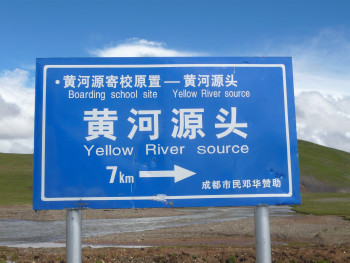
It is an ugly place. A now defunct school. A few low buildings. Garbage and mud. An unfinished bridge – our car had to stay at the other side. At the edge of this dilapidated settlement that sign: seven kilometers to the Yellow River source.

I have been waiting for four hours. Marco and Eric have left on the back of the two available motorcycles. The drivers said it was a 45 minute transfer. They would come back to pick me up.

I wait on the bridge. I wait in the courtyard. I wait in the car. It rains and I wait in the one heated kitchen.

Five hours. There are those who can wait calmly, take a nap, concentrate on something else, read a book. I am not among them. I wait and do nothing.

Seven hours. Almost dark. They show up, exhausted, cold and wet. A bit of a hellish story of ankle deep mud and knee deep water.

They have made it to the source. In mountaineering: expedition succeeded when at least one member reaches the top. No need for an expedition organizer to get there himself. Or is it? Everybody knows Hillary and Tenzing Norgay. But who remembers James Hunt?

They offer to wait for me tomorrow while I go to the Yellow River source with one of the motorbike drivers. I consider. But my heart is much more with the Mekong source that we will aim for next. I am afraid we may need the extra day spent here for that attempt. I decide we move on.

To the Yellow River source – Beating the misleading signs

Setting out from Maduo we first came to this Bull’s Head statue with the inscription underneath explaining it is a monument to the Yellow River source.

Fifty 50 meters away a stone marker even pretends you are actually there and just says: ‘Yellow River source’.

That source though is still more than 200 kilometers away. Who could be fooled into believing he is at a river source here? These markers are high on a hill between two lakes making for a beautiful viewpoint but there is no spring, no brook, no water running down from here.

We moved on. I kept track of where we were and how far we had to go by means of kilometer markers. Their numbers went up until 108, but then started counting down from 222, then became unreadable. There was only this dirt road though, so it couldn’t be we lost our way.

We stayed overnight at Maduo – not to be confused with the earlier Maduo. This one is much smaller and though transcribed in western alphabet the names seem identical, written in Chinese characters the two are different.

Soon after leaving the next morning we came to a junction with this sign.

We turned left. 41 kilometers to go. Or was it? No useful map, paper or digital, exists of this region. But I had entered the coordinates of the river’s source in my GPS and it gave me the distance to our destination as the crow flies. I soon became suspicious. We got closer – but very slowly. We ran into another car after about 15 kilometers, a fortunate coincidence in these empty parts, and asked the driver. We should have turned right.

It took a bit of a headache to work this out. But this sign is exactly correct when turned 90 degrees right. By which I mean either turn the sign including its poles right (in a horizontal way), or leave the poles where they are and turn just the sign on top of them (in a vertical way). If you can still follow.

Next post: was this final sign correct? And did we reach the river’s source?

Kid pilgrim

We met this boy between Dege and Manigango. He had left home a month ago with his aunt and uncle, nun and monk, and their journey to Lhasa and back would take another eleven. He would walk every step of the way, and every step of the way he would prostrate himself as devout pilgrims do.

Photo by Kachain Wonganan

Amazingly, his uncle said, this pilgrimage was completely his own initiative.

He looked perfectly happy, creating his own slow motion road-movie.

We met briefly, twenty minutes. Then we moved on at our pace, he moved on at his.

‘No school?’, I had asked. But his uncle taught him every afternoon. I was left wondering many more things. Did he miss his family, did they carry a mobile, did they keep in touch at all? Did they ever worry they may not get enough support of local people – no lodging, no food, no alms? How about the winter cold?

Questions that only a non-pilgrim can ask, I suppose.

A trip through Kham and Amdo

Five joined me on a trip through the eastern Tibetan lands of Kham and Amdo. They are places of awesome empty spaces to which the people add colour with their dress, prayer flags and architecture; and life with their welcoming and direct way of interacting with strangers passing by.

We cut south-north through the area, from Gyalthang (Ch Zhongdian) in Yunnan to Xining in Qinghai province – 2.000 kilometres along the shortest road, but we added another 1.000 of amazing detours via Pelyul (Ch Baiyu), Katok (Ch Gatuo) and Dege in Sichuan province and the Golok nomad area in Qinghai.

Unlike in the well-known triangle of Lhasa, Gyantse and Shigatse in Central Tibet there were no hordes of tourists. In fact we saw about five from abroad and five from China in three weeks – and zero during our detours. Unlike in Central Tibet there is no big influx of Han Chinese workers and traders. We travelled through a much purer Tibet than the Lhasa region is these days.

We were free to go anywhere – not a certainty for foreigners in these parts. Only at the junction that should lead us to Katok monastery we were stopped at a police checkpoint and told that we could not stay overnight in the area. I politely asked the young man in uniform to call his boss. He did, and was sorry to tell us his boss said ‘no’. I politely persisted, he called again, and he was even more sorry to tell us his boss still said ‘no’. We were allowed a daytime visit, before dark we were to be back at his checkpoint and move on.

Rock Art – Photo by Kachain Wonganan

One day we drove – make that: bumped, it was an awful stretch of road – along the Yangtse river between Baiyu and Dege. We were in Sichuan, across lay the other half of Kham in the Tibet Autonomous Region, forbidden territory for foreigners unless they have a travel permit. And these have been almost impossible to get in the past two years. I hope one day to have the opportunity to visit that other part of Kham.

For some more photo´s see http://www.flickr.com/photos/pieterneele/sets/72157627763666722/

The FIFA World Cup 2014

The finals in Brazil are still almost three years away. But the soccer World Cup of 2014 has started. In Asia in preliminaries of preliminaries many countries have been eliminated already.

Nepal didn’t make it. They drew 1-1 at home against Jordan but something went wrong in Amman: 9-0. I sent a somewhat compassionate message to friends in Kathmandu.

Laos is out too. They first beat Cambodia, but then lost to China: 13-3 on aggregate. I sent a somewhat compassionate message to friends in Luang Phrabang. Had it been the other way around, I would have laughed at my Chinese friends.

Syria was disqualified. Not because a strange man holds power there who kills his own people, but because in both matches against Tajikistan they fielded a player who once played for Sweden. FIFA, as its rule book stipulates, turned both Syrian victories in 3-0 defeats. I suppose those of Tajikistan knew right away. But they didn’t say anything, they figured: if they find out, he will not play next match and we may lose 4-0. We better say nothing, and they will field him again next match.

Among the other victims Macau, Malaysia, Maldives, Mongolia, Myanmar. For 23 of 43 Asian nations that entered the competition the World Cup is already over.

China is now trying in a group that precedes yet another group. They beat Singapore in my city of Kunming. International matches are played here sometimes. It will have something to do with the city’s location at 1.900 metres above sea level – an advantage if the opposition is not used to it. They then lost to Jordan. Things can still go both ways.

During China’s only successful campaign to reach the main tournament in 2002 I was a loyal supporter. Few believed they stood a chance, and I rooted for the underdog. These days China is an underdog in hardly any field anymore. If they fail – well, I kind of look forward to some malicious delight.

http://www.fifa.com/worldcup/preliminaries/asia/standings/index.html

Postscript

October 3rd 2012, flight MU5711, Kunming-Beijing

A group of young men in neat dark suits is standing apart near the gate. Curious, I move up to them. Buttons with the North Korean flag or the North Korean leader on their jackets, small labels of their German sponsor on their cabin baggage.

It is the national football team, on their way back from training at altitude in Yunnan ahead of their WC qualifier against Uzbekistan. ‘Very strong’, the official says when I try to strike up a conversation. Apparently he isn’t reassured by the fact that seven players in their current squad played in last year’s World Cup in South Africa.

I imagine the Dutch national team to be noisier than these calm and modest guys, and busy with iPhones and earphones. Not that there is any chance I‘ll ever be on a scheduled flight and in economy class with them.

Halfway through the flight I walk to the toilet in the back. Most have dozed off. Those awake seem bored. 

Waiting at the luggage belt in Beijing the seemingly oldest official is bantering with the seemingly youngest player. A shy smile. The others are laughing.

Anonymously they disappear in the passenger crowd.

Jinping’s War Cemetery

This second time, under the watchful eye of the camera, we aren’t as reverent. We mostly wonder what we will look like, even though the camera woman has told us we will feature for just three seconds in her website documentary.

We had come earlier in the day, the gardener had unlocked the gate. We had climbed the stairs through the ranks of the fallen in the 1979 war with neighbouring Vietnam. Higher up on the hill, in the oldest part of the cemetery where those who died in the revolutionary war lay buried, mister Li had approached us. He pointed out the tombstones from 1950. Mao had declared this country the People’s Republic of China in1949, and the war had been won 99 per cent. But in these far-off parts the Kuomintang still resisted. He told us about the 18 year young girl from a nearby village. She was beaten, raped by 20 men and killed. Every war produces its own horror stories. He said he still couldn’t relate this without being moved. There was nothing trite about him.

The dead are commemorated once a year. Not on a day that marks the end of a war, not with pomp and circumstance. But on Qingming, the day in April when the Chinese traditionally commemorate their deceased family members, clean their graves, clear the weeds. Many still come. Mister Li administers a fund that refunds travel expenses to those who have trouble covering their own – some come from as far away as the Northeast, 5.000 kilometres from Jinping.

It is called, somewhat belligerent and heroic, Jinping’s Cemetery of the Martyrs. But it is a peaceful place, shaded by trees, the gardener sweeps leaves.

Just back in the hotel they contact us. The management invites us for dinner. And they would like to shoot some video of us. That will become those three seconds that introduce as ‘visitors from far and wide’.*

They have put a long table in an empty space of the cemetery. Dishes are being served. There is beer. Mister Li soon is inebriated and more cheerful than in the afternoon.

We get the official numbers and stories. 768 men lay buried here. In 1979 the Chinese entered Vietnam no more than 70 kilometres. Once the Vietnamese pulled back one of their armies from Cambodia, China withdrew from Vietnam. The Chinese had attacked Vietnam in response to Vietnam’s invasion of Cambodia that toppled the Khmer Rouge regime.**

But then our camera woman, who is doing the briefing, changes course. She stresses that the Chinese and the Vietnamese people are friends. These days in Jinping county they walk across each other’s border. It was a conflict at government level. Just as the current tensions between China and Vietnam over islands in the South China Sea that both countries claim are a problem between governments, not between the people.

No unpleasant traces of nationalism run among the people who run this place. Their focus is on the human cost of war.

* The cemetery’s website is www.jplsly.com

** For a complete and objective overview of these events see Nayan Chanda, Brother Enemy, The War After the War

Cold spell

Spring in Kunming is usually sunny and warm. Every now and then a sudden cold spell interferes. The temperature drops ten, fifteen degrees to ten, twelve centigrade. Recently it went down to four. That is rare even in January.

‘Mild climate’, people say. But there is no heating here. During the first day higher temperatures don’t give way yet in homes and offices. After that you are numbed by cold sitting behind your desk. Twelve degrees? Nobody born in the West after WW II, used to heating, can imagine anymore what it is like to experience that continuously.

When communist reconstruction started in China after world war and civil war it was decided, forced by shortages, not to install heating in apartment blocks, schools, offices, factories, hospitals south of the Yangtse River – though in winter it can easily get below zero in many places there. That policy is still intact. They may have invented laughable ways of wasting energy in China (what about, in places where central heating does exist, radiators without regulators that can’t be switched off even if outside everybody is just wearing a T-shirt), leaving several hundred million out in the cold has to be commended as an efficient conservation measure.

Of course people improvised all kinds of heating devices, and today most can afford an electric heater. But the majority stoically accepts the cold. ‘Ah, just wear several layers of clothing’. People don’t whine in this country where hardship has been part of life for millennia.

During the first day the cold doesn’t give way yet in homes and offices, but outside it is driven away as abruptly as it came. Usually within a few days. This time it took two weeks.